Friday, November 27, 2009

The Walk, a Poem by My Mother, Nova Hicks Bussey, 1958


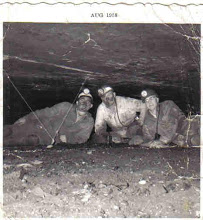
The picture on the right is a view of the David coal camp from the hills
I took a walk this morning, in the early morning breeze
A rabbit crossed my path; I heard the squirrels in the trees.

I like to walk in the morning and relieve my worried mind--
To look at nature around me, hoping a new treasure I'd find.

This morning my mind and heart were troubled. From my face, I wiped a tear.
I wanted to keep going so far up the mountain feeling God was near.

I stopped to pluck a daisy. Memories of my youth came back to me,
Telling fortunes with this beautiful flower sitting under an old, old tree.

I walked up the mountain. Sumac was low and crowded too.
Wild grapes were hanging all around, I stopped to pick a few.

I saw a snake sleeping peacefully, I moved on without any fear.
This was his kingdom and his castle, I had no right to interfere.

I stood admiring drift wood in the small mountain stream,
Scenery so beautiful, it would be any artist's dream.

My mind became less worried because exhaustion had overcome me.
I came to an opening and sat down on the soft grass, under a tall oak tree.

I sat there wondering how much further I had to go.
The path seemed to get more narrow but I'd make it if I took it slow.

I prayed as I walked the narrow path because it had become difficult to see.
I looked to see a huge rock looming, high over me.

Through a clearing I could see the top of the mountain,
It seemed to touch a bright blue sky.

Briars scratched my legs and arms, it didn't hurt.
I had to make it and I'd try.

The rest of the path was rocky, but soon I reached my goal.
I flung myself on the ground sobbing to the depths of my soul.

Rain came beating down on my face, and the wind began to blow.
I said," God, will my life always be filled with fear and hate? Please, God, I have to know".

I saw the trees bending to and fro, their leaves almost covering me.
I wiped the rain from my eyes, then I saw this small tree, unknown to me.

It was taking a beating, but its leaves were hanging on
While the leaves of the oak were on the ground. The oaks, so tall and strong.

The rain stopped as suddenly as it had begun.
I looked at that little tree (and it seemed to me, I grinned)

I said to myself,"Why, that little tree could be me."
I'd manage to hold my own because the strongest really are weak.

I started back towards home. I looked up and smiled into heaven.
It seemed to be quiet and peaceful as I went back down.
Written by Nova Hicks Bussey, 1958

Poetry: Does Language Alter Meaning

In high school, we participated in Regional Speech and Drama competitions. I remember one special event held at Pikeville College. My teacher, Mary Lou Miller, fresh out of college and only about 21 years old, approved of my reading. While I didn't win a prize, I still hold dear Renascence by Edna St. Vincent Millay.

"All I could see from where I stood was three tall mountains and a wood. Over these things I could not see. These were the things that bounded me"....

"Then, all at once, and over all, the pitying rain began to fall. Oh God, I cried, give me new birth and put me back upon the earth".


I'm sure I over-dramatized the latter line (isn't it awesome!) Mother was dramatic and loved to recite poetry to us. I probably acted out the damn thing.

I loved the reading and still quote the poem, but the judge said I pronounced Renascence wrong. I emphasized the second syllable with the "a" sound in "hat". The proper marking for that sound now escapes me.I still say it my way, and hope friend Jawahara Saidullah will provide some international input. I grew up reading many British books and still use much of the spelling, so I hope this pronunciation has something to do with that influence. I want to be right on this but will accept the judges verdict, if necessary. I think the following may prove me wrong after all:

Dictionary: re·nas·cence (rĭ-năs'əns, -nā'səns)

Do you ever hold on to these little personal failings?

Mother taught us values and morals by reciting poetry then telling us its meaning. The story, the moral dilemma, and the choices. Yesterday, after my discussion of never reaching the top of the hills behind my coal camp home, I promised to post Mother's poem, The Walk.

I'm wondering how the Appalachian homemaker's version of seeking the summit, differs from Summit by du Maurier, the renowned British wordsmith. How much does the language affect meaning? Mother always got her point across in plain if not Standard, English. She always made every thing rhyme whether it was logical or not, so at times her poetry is, on the surface, elementary. She was a primitive painter, so maybe she was a primitive poet as well. We'll see.


OK, I'm going to look for the poems.

Thursday, November 26, 2009

Cleaning Water Tanks as a Summer Job

Did anyone see the movie Australia? The water tank was a pivotal dramatic catalyst. That's how the David water tanks looked. The tanks were being built when my brother Rodney was just big enough to be running around the camp and annoying the men who were digging the ditch around the tank. He was probably trying to sell them water or something. They decided to pull a prank on Rod and told him to go down in the hole and get something for them. He walked straight into a yellow jacket or hornet's next. As they laughed at his vulnerability, Rod ran crying all the way home.

When he was 18, however, Rod and, perhaps, other coal camp boys, actually got the job of cleaning out the David water tanks. Today, I thought of him in the Australia tank with the creamy son and his mother. I imagined Rod as he scrubbed the walls all the way to the bottom and drained the sediment.After rinsing out all they could, he swept any residue into a bucket and hand carried it up the ladder. The tank was rinsed again.Remember the creamy holding on to the ladder and trying to save his mother from the rising water?

When Rod's tank passed inspection, it was filled once more with the fresh mountain water flowing from the top of the hill. Rod swears that was the cleanest water tank in East Kentucky. The company gave jobs to some of the college boys in summer to help with their expenses. My parents always appreciated this incentive to stay in the camp. That old double edged sword again.

I don't take water for granted and know the engineers performed miracles in David so we could have running water in our houses. We were proud!

Later,
Peace,
Judy

The Hills and I

Called my brother Johnny this morning at 6:30. His wife, Eda said he had gone deer hunting and would be back soon. Since I'd been up since 5 AM, I wanted him to be proud of me. He says that anyone who sleeps past 5 AM misses the best part of the day. Johnny built a pretty deluxe deer stand last year and I betcha he's up there chewing tobacco and enjoying the morning--maybe even has a little heater and some coffee going.

Or, he's just sitting in those hills behind his Wiley Branch home looking up over the ridge for the sunrise and listening to the wind through the now barren trees. Looking down at the roofs of his and his son's home and to my old place. Maybe he's listening to the creek roll by. I've done that before. If you pay close attention, the sound is magical. The wind also has a special sound in those hills. It sounds differently each season, indeed, with any change in the weather. Dry leaves versus wet leaves. Frozen branches versus limber branches. Heavy rain versus a light shower. No leaves versus full blown foliage. Did you know that when it's going to rain, maple leaves give us a warning by turning their backside to us? While this may not be in the Farmer's Almanac, I learned it by listening to the old folks and doing my own observations. It's correct.

When I lived on Wiley Branch, I loved watching the sun come and go over the hills. Watching the movement of the shadows and the light was better than a clock. What happened to the little girl who never noticed a sunset in the coal camp of her childhood? I now seek harmony with nature, it was so much a part of my childhood. The hills are eternal and always offer something new for the observant eye.

As a child, I played all day in the hills, but never really noticed the sunrise and sunset. Maybe the sun didn't shine up "Official Hollow". Maybe that's why people said we had to have the sun piped in. Our hollow was narrow. Our yard was the hillside. We looked out the back straight up a hill where Indians lurked just beyond the forest line. When we looked out the front windows, we saw another hill.On that hill, we could see wooden steps winding high up to a big house reserved for company officials. Mr. & Mrs. I. C. Spotte lived there once. He was an engineer. They were interesting people who had survived the Philippine death camps during WWII.

The Bradburys and the Strattons also lived in that house at one time or another. I baby sat for both families and felt very important. The women liked my mother and always gave her magazines like Look, Collier, & Life--real luxuries in that day and time.Toby arranged them in a flat cascade on the living room coffee table and we all read them religiously. I still read magazines from back to front. Remember the cartoon "Hazel" that was always last? I always read it first.

Back to the hill. Near the base of the wooden steps that led to the official lodging was a little mountain spring. We loved to drink water there. This summer when I took my granddaughter Savannah to David, I was sad that the spring was dry. We picked up a couple of rocks as mementos of the trip to bring home with us. Further up the hill was a huge water tank on stilts. This was the water supply for the camp. Pretty modern in it's day, I suppose. On the left of the spring, further up, sat the "Club House" where international coal buyers were lodged and treated royally. There were no Holiday Inns nearby. Mrs. Ora Howard, assisted by Ms. Justine Dawson, a David native, ran the place just like a proper British Mansion. I loved to visit them.Having started reading the Brontes at age 12, I let my imagination run wild. Ms. Howard taught me to knit and to make macaroni and cheese with real "white-sauce", a term I had never heard.If she'd said "thickenin'"I may have caught on more quickly.

On the left of the Club House the hillside was landscaped into a rather formal garden. There I saw my first gold fish pond with Lilly-pads. That's also when I began to love Adirondack chairs. I remember sitting in the sturdy, solid wood, always white painted chairs. Beyond the pond up the hill was the Shepherd Family Cemetery. I wish I had paid more attention to this beautiful old-time cemetery. I went to school with many Shepherd children over the years.The long row of wooden steps that led straight up the hill may have made the steep climb easier for those carrying the casket. I'm sure the company built them to guarantee the Shepherds access once they had bought or leased the hilly land that formed our two main hollows.The Shepherds were pioneer royalty and had been on that land since--well, maybe since the late 17th or early 18th centuries.

We're still only half way up the hill, aren't we? Behind these two houses there were just trees, grapevines, little caves, all kinds of wild flowers, and big rocks. On the clubhouse hill, way up high was "The Devil's Stool", a famous gathering place for the boys in the camp. On the bull-dozed road leading down from the official's house, the boys tied a rope to a branch so that we could swing out over a cliff. Scary stuff back then. I fell off it once and sprained my arm. I was proud, though,that they let me try.

It was fun to play house in the hills where we'd "play like this rock is the table and play like that rock is the baby bed". "P'like this rock is the coal house". "P'like you're the daddy and there's some Indians attacking us". "P'like the baby is cryin". "P'like you get shot". "P'like I'm fixin' supper"."P'like this mud pie is cornbread." "P'like this stick is my horse". I wonder if little girls and boys still say "P'like"?

Some days we were Nyoka and Judy the Jungle girl--two of our favorite "funny book" characters;and some days, most days, we would enjoy a round of cowboys and Indians. There is no place better than the hills to play hide-and-seek, go-sheepie-go, or tin can alley as night falls. We played until dark. That was our only rule: Be home by dark.

I just don't have any memory of climbing to the top of the hill or of watching the sunset over the ridge as I did later in life. We were so immersed in our natural surroundings, we didn't look up except when lying on our backs looking at the artistry of moving clouds or looking for the trail of smoke that followed the planes that were finally breaking the sound barrier. Brother Rod was a Boy Scout and worked in the Civil Air Patrol, with other Boy Scouts, using binoculars to identify planes in the aftermath of WWII. They looked for each and every plane that passed over the camp and kept an official log. They were given access to a Company telephone (no one else had one) and were to report by phone if any planes aroused their suspicion. We felt safe with Rodney being in charge. He was all of 10-12 years old. I guess coal companies would have been enemy targets. Coal was important to the War effort so many of the miners were exempt from the draft.Daddy was one of those.

I'm missing Thanksgiving in the hills this year--the first time in many years--and the thoughts of Johnny hunting in the hills behind his house triggered all these memories. Later today, I'll post "The Walk" a poem by my Mother, Nova, who actually made it to the top of the hill. I wonder what she saw?

Until then,thanks for letting me share these memories with you.
I hope this is a good day for you and yours,
Peace,
Judy

Saturday, November 7, 2009

If I'd write more often...

...there would be shorter stories, I imagine. I would stay updated and not need to write more to express that which needs expressing. The name of my blog is "Appalachian Roots" and is subtitled "Discovering My Truths". Therefore, I never know what my topic will be--historical influences or the impact those forces have had on the person I am.

I'm trying to move from the past to the present. I didn't know it would be so difficult to see myself in a new light and not in the light of my very distinctive cultural heritage. I'm astonished when reminded that we watched as "Red" Shepherd would appear on horseback from the head of our hollow. She would ride down our road, on to the company store and the post-office with various sundries hanging from her saddle.

This was in the 1950s, not really that long ago and I'm still amazed in knowing I lived in that place and time.

Cumine lived over the other hill, on the "new road" where the strawberries grew. Karen and I picked strawberries on her hill one day. It rained and Daddy came to get us in his Hudson. The car was so low it dragged on the dirt road. Daddy cussed all the way home. Karen and I just listened and hoped it wouldn't get any worse when we got home. Cumine's home was down over a hill where a cut-through the big rocks allowed poker games to be held in secrecy. That's where Adrian Shepherd was gunned down in a poker game. I went to school with Adrian's daughter, Bernice.This is a very vivid memory.Sherrif Taylor Stumbo took charge, as best I remember. I haven't checked facts on this story, just writing my memories.

Did these things really happen in my childhood home? Maybe that's why I love Western movies and books so much today.We were living on a frontier, but didn't know it.Law was just being recognized, but was still not welcome.

OK. I've many Cherokee Bill pictures and stories and hope to offer them next.

Thanks for checking in at the various intervals of my journey.


Til Then,

All that's left is life,
Peace,
Judy

Down-Sizing and Liberation

Dear Reader,

I grew up in East Kentucky where we were taught to hang on to things so we could help our children "set up housekeeping". I'm not so sure that's the practice today, since young people tend to replace everything rather than hang on to it. I regret that my son talked me into junking my good sofa because it was in bad need of new upholstery. Kids go to Value City and buy sofas for 3-400 dollars. I still don't have a sofa, because to get one as good as I had would be 2-3000 dollars. So, I assume, eventually, I'll buy at the discount house myself.

Now, my best chair is in dire need of recovering, so I'm going to get some estimates. I simply cannot junk it. I'm beginning to identify with Mrs. Habersham from Dickens' Great Expectations. My furniture is ragged, I love old clothes, even with holes. I pull 20 year old stuff from my closet and, sometimes, they let me wear it. My granddaughter wants to put me on "What Not to Wear". She says adamantly, "It's not the age of the clothes,but the style. You just can't wear that"!

Today, as I downsize, yet again, from a 3-bedroom apartment to my daughter's upstairs studio/loft apartment, I have enough stuff to add furnishings to both my son's and daughter's homes, with left over junk to store. What will it be like to not have my favorite bed and no sofa?

My beautiful bed is too big to be carried up stairs to my loft, so I'll store it for awhile--at Tom's house. I have a great twin mattress and box springs that will suffice for both a sofa and a bed. I'm giving art to both grandchildren, including a really nice Elvis poster.I gave Dawson my piano, since he's a budding rock star and writes music.

That piano has been in my home for 40 years. I gave Tom and Dawson some coal-mining antiques, including an "as-mined" map of underground sections below my home of David, Kentucky. This map, a favorite piece, was given to me by an engineering friend more than 20 years ago. I also gave Tom Uncle Rob's gavel that he used as President of the UMWA in Wayland, Kentucky in the 40s--it was a prestigious position. I gave him some mining photos and a tie tack award Daddy won for safe mining when he was a section foreman in the 50s. I had always wanted to make Dawson a ring from it and I hope Tom will.

I plan to store Nova's Primitives for later display so they will be boxed for safe keeping. Savannah is getting my original oil-on-silk painting, another treasure given me by a good friend; an original art piece by Appalachian artist, Peggy Wells; and two Ruth Bernhard photos along with the companion book of her work.

I'll keep my 5 favorite Picasso prints that I found in NYC 25 years ago for $5 each. They are beautiful, rarely seen prints, and are my favorites. I'll also keep my original Appalachian art, by East Kentucky friends Mike Keesee, Ann Meade, and Tom Whittaker. Of course I'll keep my original charcoal nudes, by Lexington friend, Elsie Harris.

My latest addition is an original by Chris Eaton, abstract and colorful. I must keep it. Maybe artist/architect friend Maryam will come help me make the most use of my new space. My loft is rapidly filling up, isn't it? Maryam will probably suggest a midnight burning of my material chains.

Tom's been trying to get my beautiful glass, octagon table top for years. I'm holding out on that one. Today I took Mother's antique coffee grinder to Sandy's where I'll integrate my favorite kitchen stuff with hers--if she can tolerate me.

Tommy will take the Italian cutting board and framed poster with poem by Talleyrand--mementoes from our coffeehouse days. I'm wondering who should take the Italian Mama Roe fondue pot and pitcher. Am I too old to have a fondue party? The loft may be the perfect place. My true friends like sitting on the floor anyway so having no sofa shold be just fine.

Sandy is agreeing for me to put my book colllection in her dining room. Will they all hate me when this move is final?

Why am I writing about these mundane things? We all know posessions have no real value. What is important is my ability to transition with grace. I'm thinking it will be awesome to re-identify my environment in some new and interesting way. The boxes of books and pictures will, somehow, set the tone.

I'm writing about this because I have realized that fewer posessions, fewer responsibilities, lower rent (smile), will afford me a higher style of freedom, yet keep me close to those I love.

I may be able to fly to Geneva, Switzerland and spend a couple of weeks with wonderful friends Jawahara Saidullah and her husband, Bijoy Sagar.They are 2 hours from Milan,Italy and 5 hours from Paris,France.I've never thought much about my own freedom, but now I know I've been held captive.

I talked to a friend today who is enjoying the same experience of giving things away. He likes being present to the pleasure his children and grandchildren experience with his treasures. We agreed a new form of liberation is possible.

With no strings of any magnitude, this coal-camp dreamer may be able to do some world traveling. My next dream is to visit friends in Austrailia--Melbourne in the south and Sidney in the North, England, Germany, and Southwest USA.


I yearn for hours of conversation, good meals and good wine with Bijoy, Jawahara, Geoffrey, Kathy, Fritzi, Barbara, Glenn y Patricia, and other friends I've missed over the years. Sobre Mesa, everyone!

Liberation may result from living in the loft!

Peace,
Judy

Afterthought: "Twice I was a mother, once I was a wife. Tore out all the pages and all that's left is life. Tomorrow, oh tomorrow, I wonder who I'll be. Got scrapbooks filled with photographs and none of them, not one of them is me."

Thursday, November 5, 2009

Going to Thanksgiving: Personal Memories


This will be the first year in at least 44 years that our family has not reunited to celebrate Thanksgiving Day. We "go to" Thanksgiving at Toby and Bruce's home and in the past 3-4 years to brother John's on Wiley Branch. People come from all over to share in the day. The six Bussey siblings are usually there. If one's missing they will regret the day and be told by sister Toby that they should have made better plans. Over the years, some things have remained constant. There is so much laughter and talk. And, the babies keep coming! Toby counts 45 as a small crowd.

There is an early meal--12 Noon or 1 PM. I'm always late and my arrival has been a highlight for many years now. I always bring the scalloped oysters or seafood casserole, so I'm usually forgiven. Once we're all there,Bruce asks the blessing while Tom O'Rourke, Sr.& Jr, Margo, and Johnny act mischievous. Then the feast begins. We've grown to more than 60 present at most Thanksgivings.

Sometimes Aunt Ora, Wonnell and Garland show up from Daddy's side. Sometimes Bill & Nancy Bussey, which is such a treat. Sometimes, Jimmy,Valerie and Shirley show up from Mother's side. Recently mother's only living sibling, Aunt Olga Trusty, showed up with son John Richard and daughter, Debbie Trimble. My five siblings, myself, and our descendants account for everyone else. Toby and Bruce alone, now have 24 descendants.

The food is southern/mountain traditional. Brother Johnny & wife Eda have recently hosted some Thanksgivings to help Toby out. She had a tough job for many years and never complained. She just wanted to make sure everyone came and brought any friends they wanted. Over the years all of us have brought someone to share in the day. We have baked turkey, smoked turkey, smoked pork, dressing, shuck beans (no one could cook shuck beans like Peggy), sweet potatoes, mashed potatoes, macaroni salad, fruit salad, rolls, cranberry salad, deviled eggs, kushaw or squash, gravy,oyster stuffing, and so many desserts I can't even list them. The standards are frozen fruit salad, pumpkin rolls, jam cake, and apple pie (United Baptist style), pumpkin pie. Then, there were the touch football games, the hikes into the hills and up to the cemetery, and the naps.

Since the first round of eating begins by 1 PM, we have another meal around 6 PM.Don't you love left-over dressing and gravy? Going "to" Thanksgiving is a great memory for all of our children. Toby and Bruce let everyone do just exactly what they want to do. If the kids want to eat on the new sofa, that's ok. If the kids want to ride their trikes and bikes down cemetery hill, that's ok too. If the kids--or adults--spill pop or coffee on the furniture, Toby doesn't mind at all. They set up tables in the family room where the kids later play games, Karen and I sang "Sincerely" and children performed. We always danced a little to the old rock and roll music, when we could pull the guys away from the football on TV. I have it recorded all on my first edition back-pack video films. Pure madness, pure fun! That's why all the kids loved going to Thanksgiving at Tutor Key, Kentucky.

Friday was always Italian day. Karen married Irish-Italian and we have Giganti Sicilian cousins so Friday was the day to celebrate our diversity. Karen cooked her famous spaghetti and meatballs. Rose Burnosi O'Rourke, Karen's beloved mother-in-law brought her homemade ravioli from Latrobe, Pennshyvania to add to the feast. The past 5-10 years, brother Johnny tries to invade the Italian kitchen so we watch him carefully so Karen can cook the way she wants to. There's always a little steam brewing when Johnny and Karen meet at the stove on Italian day.

Saturday is soupbean and cornbread day. God, it's good to get back to basics.

One of my favorite Thanksgiving memories was at Toby and Bruce's house on Davis Branch around 1969. My son Tommy was only 5 years old and had never been able to say his "r"s. That day he charged into the kitchen happily yelling, "MotheRRR, I shot a BiRRd!" I can hear him now.

Then, there was a special hike to the top of the hill behind our house on Wiley Branch. I was backpacking my famous huge video camera and have films of the whole day. As Rose O'Rourke and I went up the path, we came across 2 of Hershell Pack's horses. I was afraid to walk past them, so Rose and I climbed straight up the steep hill instead of the beaten path that wound its way to the top. I kept my camera on. We struggled for breath and laughed all the way. coming back down, I captured the sound of my creek rambling on to Georges Creek and towards the Levisa Fork of the Big Sandy. A wonderful sound.

Uncle Johnny would always take the young'ens on hikes. He taught them the names of trees, which bark to chew, and how to track certain animals. He showed them how to dig in the earth, until water surfaced for a fresh drink--just as the Native Americans had done. Over the years, I hear that Johnny made a few of the kids chew tobacco. They'd do anything for Uncle Johnny and he just laughed when they turned green.

Our memories are fully entrenched in each of us, each in our own way. I know we will all remember going "to" Thanksgiving over the past half century. I appreciate Toby and Bruce, and more recently, Johnny and Eda for hosting our group.

As for Thanksgiving in the coalcamp, I have few memories. I know we had turkey, cornbread dressing,gravy, potatoes, and probably baked sweet potatoes,and shuck beans. Mother's dressing was all homemade, starting with cornbread. The finished product was rich and greasy and delicious. Others will have to help me with this memory. Was this day a disaster like other holidays, when tempers clouded all festivities? Did we visit Granny and Pap. I'm stuck here.

The celebration of Thanksgiving was certainly a big event at school. We painted beautiful turkeys, pilgrims, & pumpkins, in tempra paint on the school windows. And, every year, the big event was the Thanksgiving Play. We dressed as pilgrims in black dresses and white bonnets and aprons. The boys were some kind of stack hat. The girls had names like "Prudence" and "Patience". One of the famous lines was, "Speak for yourself, John".

Mother couldn't sew a lick and God only knows how she got our costumes made. Layman Shepherd built us a stage in the gym and put folding chairs out for the audience. Everyone in the camp would come. We hid when the Indians attacked then, over time, befriended the Indians and celebrated and gave thanks with a huge feast of turkey & corn & bread & onions. I'm sure this was the beginning of cornbread stuffing.Our program always ended in the song, "We gather together to ask the Lord's blessing...". David Grade School was big on plays. There was always some form of propriety placed among our crude celebrations.

I hope everyone has a memorable Thanksgiving this year. It seems fitting and proper that we chose to change our tradition this year--the same year we lost our eldest sibling, Peggy. Her spirit will be with each of us wherever we are.

I wish you a good day of thanksgiving for whatever love, nourishment, and moments of peace you are offered. I'm thankful for all I receive.


Peace
Judy